This is my first time I joined local in-land tour in China. In the day we gather in one place at Martyr's park in Guangzhou and confirmed our name for our seats to one of the organizer.
After a while waiting the bus coming and almost an hour late, at last, we departed by bus from Guangzhou at around 19:30, and arrived at Yangshou at around 02:30 morning. and I have paid only RMB220/person to join this local 3 day tour to Yangshuo (Guilin) from Guangzhou. Do not expect to stay at the star hotel....not even close to 1 star hotel though.
But overall, it was fun and we had great time.
Yangshuo lies in the northeast of Guangxi Province and to the southeast of Guilin city. The special geography gives it breath-taking beauty while over 1,400 years of history bless it with a deep traditional culture. The diverse ethnic minority groups including Hui, Zhuang, Yao and others, enrich it with special folk cultures represented by their various festivals; while many foreign residents add exotic flavors to its fascination.
Assembling Dragon Cave
In the morning we start with Assembling Dragon Cave. It is a pearl inlaid in Yangshuo scenery characterized by pretty rocks, strange caves and clear waters. Located six kilometers (3.7 miles) south of Yangshuo County, Assembling Dragon Cave is at the foot of Ma Hill (Horse Hill) between Moon hill and Big Banyan, comprising Black Cave and Water Cave. The cave gets its name from the surrounding peaks, like circling dragons, and the numerous stalactites with shapes suggesting images of dragons in diversified postures.
This is the only Karst cave in Yangshuo which can be admired both by land and by boat. It is over 1,000 meters (1,094 yards) long, 25 meters (82 feet) high at its highest point and 30 meters (33 yards) across at its widest with a quarter of the sightseeing route navigable by boat. Next to the watercourse there is a plank road equipped with guardrails. Visitors can watch the inner sights on foot or by boat as they like.
The scenery inside is an extraordinary masterpiece of nature without any artificial management. In it, the spectacular Karst scenery is too amazing to miss. There are too many astonishing sights such as stalagmites, stalactites, stone pillars, waterfalls, and underground rivers for visitors to take in. The pool inside it is the seemingly bottomless Wudi Pool. Floating along the underground river in the pool, visitors can row their boats through the cave and come out from the back while experiencing a drop height of several meters.
There are many enthralling waters and mountains gathered around it, as well as many pavilions, terraces, and towers built in the style of local minorities' architecture. Antiphonal singing with 'Sanjie Liu' (an excellent folk singer of Zhuang ethnic minority in ancient China) can also entertain visitors on their trip.
Above-water Scenic Area
Along the lower reaches of the Li River lies the Sanjie Liu Above-water Park, where the film 'Sanjie Liu' was made. This is a picturesque environment consisting of pure water, green hills and farm houses. You can roll a bamboo raft and catch fish in the water, or you can act as Brother Aniu and sing a musical dialogue with the performer of Sanjie Liu.
West Market
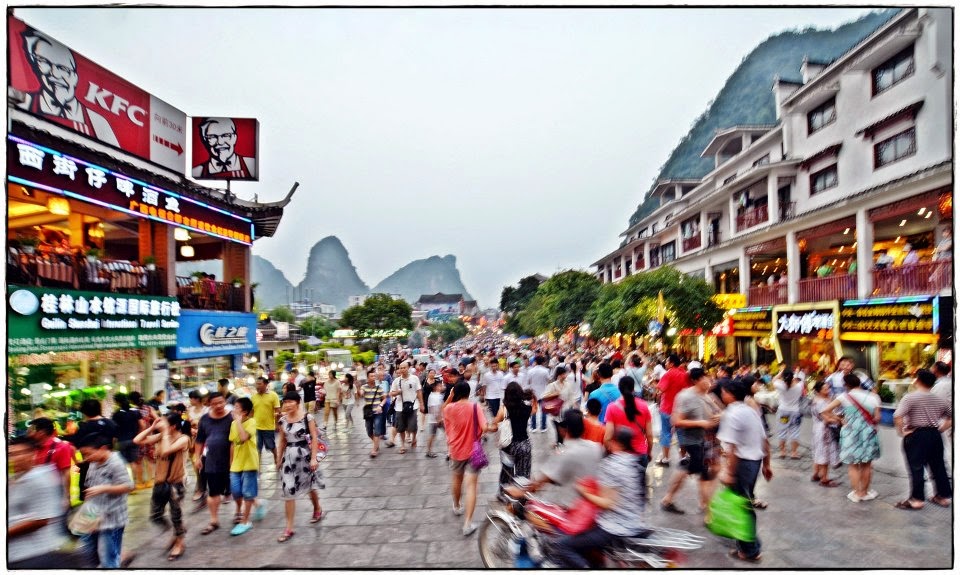 West Street is the oldest street in Yangshuo with a history of more than 1,400 years. Situated at the center of Yangshuo County, the street has become, since the 1980's, a window of eastern and western culture and the biggest 'foreign language center' in China. It is the most prosperous district in Yangshuo, and, each year, approximately 100,000 foreigners come here on their travels or to attend advanced studies. Visitors are attracted to West Street by its unique mix of cultures.
The street is 517 meters (1,696 feet) long and 8 meters (26 feet) wide, meandering in an 'S' along its length. Being completely paved with marble it is a typical example of a southern China street. It is greatly admired by foreigners for its simple style and courtyard-like setting. There is a saying about it that 'half is village while the other half is stores'.
Impression Sanjie Liu
Not far from West market, It's a must see show at night if you were in Yangshuo, ticket is (around) RMB200/person.
Tips : Better not buy any ticket at West Market, better come directly to the area and buy ticket at the official ticket box.
This is the world largest natural theater which utilizes the waters of the Li River as its stage, with twelve mist shrouded hills and the heavens as its backdrop. Mist, rain, moonlight, the hills and their inverted reflections in the river all become the ever-changing natural background. Its auditorium is housed on the natural islands of the river with the audience standing on the designed terraces, surrounded by green plants. The sound equipment here cannot be seen because it is in harmony with the natural environment. The valleys, the hills, the cool breeze and the gurgling streams are all elements contributing to the three-dimensional sound effect. Day by day, different weather offers different sceneries with the four seasons refreshing the performance as well, so you will have unique experience every time you watch it. This is really a new concept opera using nature as an integral part of its performers; hence its name - 'Human's Masterpiece Cooperated with the God'.

The performance is divided into seven chapters including the preface and epilogue. At the beginning, the lights are all turned off and the image of Sanjie appears indistinctly in the sky with beautiful songs 'Sing the folk songs, here I am singing and there you are echoing...'. As the lights come up, the twelve hills appear in front of the audients; and a small fishing boat is rowed from the hills. This is the Preface - the Legend of Hills and Rivers.
The first chapter is the Red Impression: Folk Songs. On the water, many fishermen are rowing their bamboo rafts in a column. Either standing or squatting, they hang the large red silk in the sky and or upon the water. This red picture symbolizes the enthusiasm and praises the labors of the local people.
The second chapter is the Green Impression: Garden. The color green symbolizes nature as well as the vitality. Among the green hills and rivers, the smoke from cooking fires curls upward; herders are heading home with their cattle under the gleam of the sunset. The women, washing clothes beside the water are waiting for their husbands who are rowing the fishing rafts back home. This chapter reveals the peaceful and happy life of the local people.
The third chapter is the Golden Impression: Fishing Lights. Hundreds of bamboo rafts with golden fishing lights are spreading all over the river. The rafts, gently rocking make the golden fishing lights dance upon the waters, the straw rain capes, the frolic cormorants and the hills construct a perfect picture describing the simple existence of the people around the Li River.
The fourth chapter is the Blue Impression: Love Songs. Under the deep blue sky, and on the dark blue water, the performer of Sanjie is singing classical love songs. Then, a crescent-shaped boat with a charming fairy dancing in is flying onto the surface of the water. A group of pretty and young girls, dressed in red or white are bathing around the boat. In this blue world, these beautiful girls seem to become the notes of Sanjie's love songs.
The last chapter is the Silvery Impression: Performance Grand Ceremony. As the 'Wonder of Lijiang Culture', this scenery reflects the traditional ceremony in Sanjie's hometown according to the legend. Over 200 Zhuang girls form a long column across the bridge over the Li River. Their silver dresses make the river shimmer in a mysterious manner.
In the Epilogue, the fishing rafts are rowed farther and farther from the audience while the beautiful songs of Sanjie are still echoing among the hills. The girls on the bridge present their thanks for the audience with their affectionate folk songs.
Except for the perfect seven pictures, the performance also boasts both modern and classical music played by famous musicians of China. Additionally, there are in excess of 600 performers, all of whom are local people of the Li River. They present the reality of life for the people in Sanjie's hometown through their primitive and wonderful performances.
Butterfly Spring Park
 It is located in the best traveling place of Moon Hill Scenic Area in Yangshuo, occupying an area of 36,000 square meters (8.9 acres). It is named after a butterfly-like stalactite found in a grotto of this beautiful park. As a locale which brings together both a unique landscape and a rural setting, it is a typical representative of ecotourism sites in Yangshuo.
At the entrance to the Butterfly Spring Park there is a huge Monarch Butterfly model mounted on a cliff beside the gate. The model has an area over 280 square meters (0.07 acres). It looks so vivid that people may think the butterfly is waving its wings to welcome visitors. He Jingzhi, a famous poet in China, visited here and was so astonished by the huge butterfly model that he wrote an inscription titled the No.1 Butterfly under the Heaven to praise it.


.jpg&container=blogger&gadget=a&rewriteMime=image%2F*)


