Sponsored Links

Friday, July 18, 2014

World's First Holographic Smartphone

Chinese company releases 'world's first' holographic smartphone


A Chinese firm rolled out what it claims is the world's first-ever holographic smartphone on Thursday afternoon, 18 July 2014,  in Beijing.

Called the Estar Takee 1, the smartphone generates holographic images with four front-facing cameras that track users' eye movements to create 3D images, an approach that's been likened to technology employed withAmazon's Fire Phone.

Digital Trends elaborates:
Does that make the world’s first claim redundant? Maybe not. A promo video, along with the official page advertising the device, all make it seem like the Takee takes its holographic effect and moves it beyond just the interface, and apply it to games, movies, video calls, and a variety of other interesting features. However, without seeing the device in action, it’s difficult to know exactly how true all this is.


For example, the video shows the phone “projecting” a 3D image off the screen, whether it’s from an app or an incoming video call, which is really exciting. If it can really do it. The footage gives the impression everyone can see the holographic boy on the screen, but if the cameras are only tracking the user’s eyes, that probably won’t be the case. The same can be said for the explosions, racing cars, and 3D galaxies.The cameras can recognize hand gestures, allowing the user to swipe in the air to unlock the phone and navigate home screens—a feature which Digital Trends points out has been boasted by an in-the-works Nokia Windows phone.


The phone otherwise features a 5.5-inch1080p screen, a 13-megapixel camera, 32GB of memory and a 2GHz octa-core MediaTek processor with 2GB of RAM. It will be available in black, white, and apparently one model will be wrapped in 18k gold.

Liu Meihong, CEO of ShenZhen Estar Displaytech Co., Ltd., said the company has invested millions of RMB in the invention and foresees the holographic tech being applied to online games, music, maps and navigation.


Tuesday, July 15, 2014

Hunan Style King Fish Head

Hunan style super spicy steamed Fish Head


When you tell somebody about a Hunan restaurant, always begin with the steamed fish head. Hunan Mao's most famous dish is the spicy fish head. The fish head will be large, probably from an enormous carp or similar freshwater species, thus comical, and it will be frosted with the chopped blend of dried, fresh and fermented chiles that give Hunanese cooking its reputation for head-snapping heat. The head is surprisingly meaty.


Recommended Hunan style restaurant :

Dongting King Fish Head Cuisine 洞庭鱼头王 (Dòng Tíng Yú Tóu Wáng)
(because this restaurant has many branches in Guangzhou city, so better ask your taxi driver/hotel staff to show you the nearest one)

The 2 branches that I know :

Near Sun Yat Shen University (Zhong Da Fabric Market)
洞庭鱼头王 
3层
78 怡乐路, 海珠区, 广州市, 广东省, 510220
Telp : 020 3431 7662


Near Ganding Subway Station (Computer Wholesale Market)
洞庭鱼头王
广东省广州市天河区龙口东路10号 ‎ 东北 12376 公里
Telp : 020 8753 8593


Monday, July 14, 2014

Summer 2014 in Sanya


Over 1,000 swimsuit-clad beach-goers took part in this massive "Bikini Party" in Hainan province over the weekend. Eat your hearts out.


The men and women gathered in Sanya, Hainan (the beaches of which are usually rife with naked, middle-aged men) to promote healthy sport activities, and, of course, tourism.
The party kicked off at the Wuzhizhou Island of Haitang Bay on July 12.

More than a thousand attendees from all over the world joined the event, including pop stars and fitness instructors, and participated in a series of beach activities like a mini marathon, yoga competitions and a ZUMBA dance performance.
[via Oriental Daily]

Modern building in Beijing

Who said in Beijing, there is no modern building? there are so many new modern building these days in Beijing such as this SOHO GALAXY in central of Beijing.
SOHO China is honored to entrust the leading design firm, Pritzker Prize winning Zaha Hadid Architects, to lend their design concept to this development. The Laureate Pritzker Prize has been considered the "Nobel Prize" of architecture. Zaha Hadid was the first female recipient of this prize since its establishment 26 years before. Full of imagination and surrealism, this unique design concept makes Galaxy SOHO a new architectural landmark in Beijing on par with the Bird's Nest National Stadium and the CCTV Tower. Zaha’s master pieces in China include: Guangzhou Opera House, Galaxy SOHO and SOHO Peaks in Beijing, Sky SOHO in Shanghai.


The National Centre for the Performing Arts (NCPA)

Colloquially described as The Giant Egg, is an opera house in Beijing, People's Republic of China. The Centre, an ellipsoid dome of titanium and glass surrounded by an artificial lake, seats 5,452 people in three halls and is almost 12,000 m² in size. It was designed by French architect Paul Andreu. Construction started in December 2001 and the inaugural concert was held in December 2007.
The location, immediately to the west of Tiananmen Square and the Great Hall of the People, and near the Forbidden City, combined with the theater's futuristic design, created considerable controversy.Paul Andreu countered that although there is indeed value in ancient traditional Chinese architecture, Beijing must also include modern architecture, as the capital of the country and an international city of great importance. His design, with large open space, water, trees, was specially designed to complement the red walls of ancient buildings and the Great Hall of the People, in order to melt into the surroundings as opposed to standing out against them.


CCTV Headquarters 
Designed by the Pritzker Prize-winning Dutch architect Rem Koolhaas, the new CCTV building is one of the largest office buildings in the world. The angular 49-story towers appear about to topple, yet the structure is carefully designed to withstand earthquakes. Jagged cross sections made with some 10,000 tons of steel form the sloping towers.
Home to China's only broadcaster, China Central Television, the CCTV building has studios, production facilities, theaters, and offices.


The main building is not a traditional tower, but a loop of six horizontal and vertical sections covering 473,000 m2 (5,090,000 sq ft) of floor space, creating an irregular grid on the building's facade with an open center. The construction of the building is considered to be a structural challenge, especially because it is in a seismic zone. Because of its radical shape, it's said that a taxi driver first came up with its nickname dà kùchǎ (大裤衩), roughly translated as, "big boxer shorts". Locals often refer to it as "big pants".
The building was built in three buildings that were joined to become one and a half buildings on 30 May 2007. In order not to lock in structural differentials this connection was scheduled in the early morning when the steel in the two towers cooled to the same temperature. The CCTV building was part of a media park intended to form a landscape of public entertainment, outdoor filming areas, and production studios as an extension of the central green axis of the CBD.

The Office for Metropolitan Architecture won the contract from the Beijing International Tendering Co. to construct the CCTV Headquarters and the Television Cultural Center by its side on 1 January 2002, after winning an international design competition. The jury included architect Arata Isozaki and critic Charles Jencks. It is among the first of 300 new towers in the new Beijing CBD. Administration, news, broadcasting, and program production offices and studios are all contained inside.
CCTV Headquarters was officially opened by the Chairman on 1 January 2008. Among the distinguished guests at the opening were Hu Jintao, Jiang Zemin, Wen Jiabao and Guo Jinlong


Sunday, July 13, 2014

Yangshuo (Guilin)


This is my first time I joined local in-land tour in China. In the day we gather in one place at Martyr's park in Guangzhou and confirmed our name for our seats to one of the organizer.


After a while waiting the bus coming and almost an hour late, at last, we departed by bus from Guangzhou at around 19:30, and arrived at Yangshou at around 02:30 morning. and I have paid only RMB220/person to join this local 3 day tour to Yangshuo (Guilin) from Guangzhou. Do not expect to stay at the star hotel....not even close to 1 star hotel though.


But overall, it was fun and we had great time.


Yangshuo lies in the northeast of Guangxi Province and to the southeast of Guilin city. The special geography gives it breath-taking beauty while over 1,400 years of history bless it with a deep traditional culture. The diverse ethnic minority groups including Hui, Zhuang, Yao and others, enrich it with special folk cultures represented by their various festivals; while many foreign residents add exotic flavors to its fascination.


Assembling Dragon Cave


In the morning we start with Assembling Dragon Cave. It is a pearl inlaid in Yangshuo scenery characterized by pretty rocks, strange caves and clear waters. Located six kilometers (3.7 miles) south of Yangshuo County, Assembling Dragon Cave is at the foot of Ma Hill (Horse Hill) between Moon hill and Big Banyan, comprising Black Cave and Water Cave. The cave gets its name from the surrounding peaks, like circling dragons, and the numerous stalactites with shapes suggesting images of dragons in diversified postures.
This is the only Karst cave in Yangshuo which can be admired both by land and by boat. It is over 1,000 meters (1,094 yards) long, 25 meters (82 feet) high at its highest point and 30 meters (33 yards) across at its widest with a quarter of the sightseeing route navigable by boat. Next to the watercourse there is a plank road equipped with guardrails. Visitors can watch the inner sights on foot or by boat as they like.


The scenery inside is an extraordinary masterpiece of nature without any artificial management. In it, the spectacular Karst scenery is too amazing to miss. There are too many astonishing sights such as stalagmites, stalactites, stone pillars, waterfalls, and underground rivers for visitors to take in. The pool inside it is the seemingly bottomless Wudi Pool. Floating along the underground river in the pool, visitors can row their boats through the cave and come out from the back while experiencing a drop height of several meters.


There are many enthralling waters and mountains gathered around it, as well as many pavilions, terraces, and towers built in the style of local minorities' architecture. Antiphonal singing with 'Sanjie Liu' (an excellent folk singer of Zhuang ethnic minority in ancient China) can also entertain visitors on their trip.


Above-water Scenic Area
Along the lower reaches of the Li River lies the Sanjie Liu Above-water Park, where the film 'Sanjie Liu' was made. This is a picturesque environment consisting of pure water, green hills and farm houses. You can roll a bamboo raft and catch fish in the water, or you can act as Brother Aniu and sing a musical dialogue with the performer of Sanjie Liu.


West Market
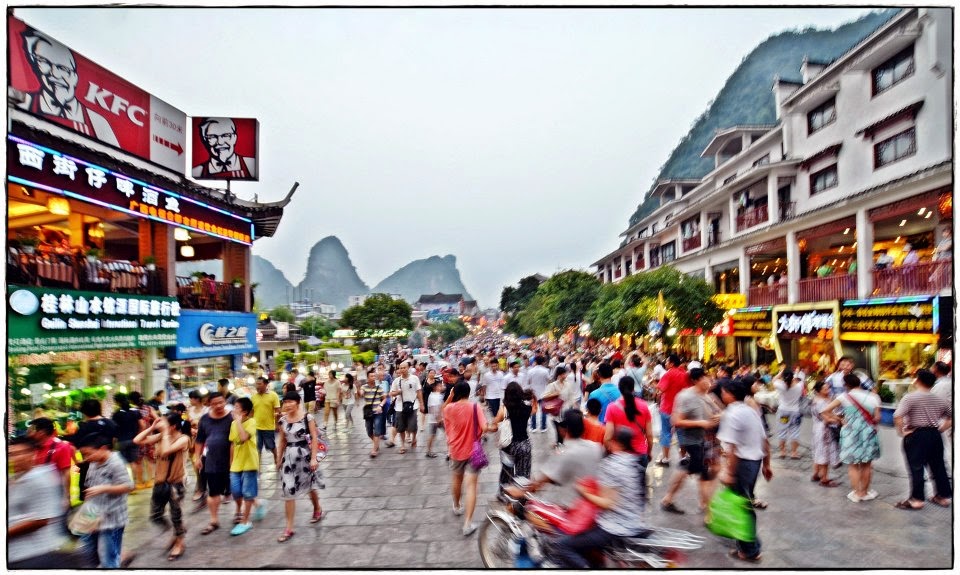


West Street is the oldest street in Yangshuo with a history of more than 1,400 years. Situated at the center of Yangshuo County, the street has become, since the 1980's, a window of eastern and western culture and the biggest 'foreign language center' in China. It is the most prosperous district in Yangshuo, and, each year, approximately 100,000 foreigners come here on their travels or to attend advanced studies. Visitors are attracted to West Street by its unique mix of cultures.

The street is 517 meters (1,696 feet) long and 8 meters (26 feet) wide, meandering in an 'S' along its length. Being completely paved with marble it is a typical example of a southern China street. It is greatly admired by foreigners for its simple style and courtyard-like setting. There is a saying about it that 'half is village while the other half is stores'.


Impression Sanjie Liu


Not far from West market, It's a must see show at night if you were in Yangshuo, ticket is (around) RMB200/person.


Tips : Better not buy any ticket at West Market, better come directly to the area and buy ticket at the official ticket box.


This is the world largest natural theater which utilizes the waters of the Li River as its stage, with twelve mist shrouded hills and the heavens as its backdrop. Mist, rain, moonlight, the hills and their inverted reflections in the river all become the ever-changing natural background. Its auditorium is housed on the natural islands of the river with the audience standing on the designed terraces, surrounded by green plants. The sound equipment here cannot be seen because it is in harmony with the natural environment. The valleys, the hills, the cool breeze and the gurgling streams are all elements contributing to the three-dimensional sound effect. Day by day, different weather offers different sceneries with the four seasons refreshing the performance as well, so you will have unique experience every time you watch it. This is really a new concept opera using nature as an integral part of its performers; hence its name - 'Human's Masterpiece Cooperated with the God'.


The performance is divided into seven chapters including the preface and epilogue. At the beginning, the lights are all turned off and the image of Sanjie appears indistinctly in the sky with beautiful songs 'Sing the folk songs, here I am singing and there you are echoing...'. As the lights come up, the twelve hills appear in front of the audients; and a small fishing boat is rowed from the hills. This is the Preface - the Legend of Hills and Rivers.
The first chapter is the Red Impression: Folk Songs. On the water, many fishermen are rowing their bamboo rafts in a column. Either standing or squatting, they hang the large red silk in the sky and or upon the water. This red picture symbolizes the enthusiasm and praises the labors of the local people.
The second chapter is the Green Impression: Garden. The color green symbolizes nature as well as the vitality. Among the green hills and rivers, the smoke from cooking fires curls upward; herders are heading home with their cattle under the gleam of the sunset. The women, washing clothes beside the water are waiting for their husbands who are rowing the fishing rafts back home. This chapter reveals the peaceful and happy life of the local people.


The third chapter is the Golden Impression: Fishing Lights. Hundreds of bamboo rafts with golden fishing lights are spreading all over the river. The rafts, gently rocking make the golden fishing lights dance upon the waters, the straw rain capes, the frolic cormorants and the hills construct a perfect picture describing the simple existence of the people around the Li River.


The fourth chapter is the Blue Impression: Love Songs. Under the deep blue sky, and on the dark blue water, the performer of Sanjie is singing classical love songs. Then, a crescent-shaped boat with a charming fairy dancing in is flying onto the surface of the water. A group of pretty and young girls, dressed in red or white are bathing around the boat. In this blue world, these beautiful girls seem to become the notes of Sanjie's love songs.


The last chapter is the Silvery Impression: Performance Grand Ceremony. As the 'Wonder of Lijiang Culture', this scenery reflects the traditional ceremony in Sanjie's hometown according to the legend. Over 200 Zhuang girls form a long column across the bridge over the Li River. Their silver dresses make the river shimmer in a mysterious manner.


In the Epilogue, the fishing rafts are rowed farther and farther from the audience while the beautiful songs of Sanjie are still echoing among the hills. The girls on the bridge present their thanks for the audience with their affectionate folk songs.


Except for the perfect seven pictures, the performance also boasts both modern and classical music played by famous musicians of China. Additionally, there are in excess of 600 performers, all of whom are local people of the Li River. They present the reality of life for the people in Sanjie's hometown through their primitive and wonderful performances.


Butterfly Spring Park

It is located in the best traveling place of Moon Hill Scenic Area in Yangshuo, occupying an area of 36,000 square meters (8.9 acres). It is named after a butterfly-like stalactite found in a grotto of this beautiful park. As a locale which brings together both a unique landscape and a rural setting, it is a typical representative of ecotourism sites in Yangshuo.
At the entrance to the Butterfly Spring Park there is a huge Monarch Butterfly model mounted on a cliff beside the gate. The model has an area over 280 square meters (0.07 acres). It looks so vivid that people may think the butterfly is waving its wings to welcome visitors. He Jingzhi, a famous poet in China, visited here and was so astonished by the huge butterfly model that he wrote an inscription titled the No.1 Butterfly under the Heaven to praise it.


Sunday, July 6, 2014

Zhanjiang Chicken


Zhanjiang Chicken (a dish originating in the Zhanjiang region of western Guangdong) is popular on Cantonese menus. Many gourmets go for its robust, savory flavor and deep seasoning, sometimes with ginger.

Friday, October 15, 2010

Nanchang (Jiangxi Province)

October 15, 2010

We arrived at Nanchang city (Jiangxi Province) at 23:53PM at night after a long more than 3 hours train journey from Yiwu.

Train ticket from Yiwu - Nanchang by CRC "D" train : Second Class RMB 158, First Class RMB 188)

We had booked a hotel via CTRIP (a China online travel service provider), and we could get a reasonable price, RMB 139 a night at 3 stars hotel, Yejin Business Hotel, which is only a walking distance of 0.5km from train station, so we don't have to rent a taxi from train station which they (maybe) will overcharge if they know you are foreigner.

When arrived at the train exit, there were so many people offering you taxi or their personal car. For us, we just find a directions to our hotel which is at South Erqi Road (Erqi Nan Lu).
It's quite easy to get, as there were English direction sign.
We walked along the street, which was not as crowded as in the train station, there were only 2 or 3 other people walking in the street, some shops were still open, even though you have to be cautious, but it still safe to walk.

After a few minutes walking from the train station, passing one very bright shop with many young girls inside along the way, we have found our hotel, Yejin business Hotel. We also saw some barbecue, fried dumpling (chien bao), stew pot street food stall near to our hotel. Looks like delicious as many locals were eating together.


Fried Dumpling (Chien Bao), price 1Yuan (US$ 0.15) =4pcs

Husband and wife selling barbecue (price from 1 -2 Yuan (US$ 0.15-0.24)/pc)


Nanchang city at night


Early in the morning, October 16, 2010, we started our journey to Tengwang Pavilion (Pavilion Prince Teng) by taxi from the hotel, it took RMB 18 to reach there.

Same like some other city in China, taxi in Nanchang also has a separator cage from driver
and back passenger, and the different is there is a small camera at the passenger front seat, may be can record who sit there.


TENGWANG PAVILION

Tengwang Pavilion is Nanchang's main symbol, it is the one of four great towers of China and setting for famous poem Tengwang Ge Xuji by Wang Bo during the Tang Dynasty. Tengwang Pavilion is towering pavilion dating to 653, on the east bank of Gan River.


Ticket cost : RMB 50 (Adult), RMB 25 (Student)


THE STAR OF NANCHANG

The Star of Nanchang is a giant 160 metre (525ft) tall Ferris wheel located in eastern Chinese city of Nanchang.
Ticket cost : 50 Yuan
The star of Nanchang City, situated by the side of Ganjing River, is unofficially the world's highest Ferris wheel at almost 162 meters, 25 meters higher than the Eye of London lied at the beach of Times River England.


Public Bus at Nanchang


Taxi & buses are the most popular ways of getting around, bus journey being 1 Yuan per person.
However you will probably find that during peak times both are nearly impossible.


AIRPORT BUS from Nanchang Railway Station


" Transit Bus on Airfield" = Airport Bus


Fare : RMB 10/person

It has some stops from Railway Station to the Airport, takes about 1 hour to reach the airport.

NANCHANG AIRPORT

Nanchang is the city of porcelain.
You can find many of porcelain souvenirs at the airport, but of coure price would be higher than you buy at the city.