Sponsored Links

Monday, July 14, 2014

Modern building in Beijing

Who said in Beijing, there is no modern building? there are so many new modern building these days in Beijing such as this SOHO GALAXY in central of Beijing.
SOHO China is honored to entrust the leading design firm, Pritzker Prize winning Zaha Hadid Architects, to lend their design concept to this development. The Laureate Pritzker Prize has been considered the "Nobel Prize" of architecture. Zaha Hadid was the first female recipient of this prize since its establishment 26 years before. Full of imagination and surrealism, this unique design concept makes Galaxy SOHO a new architectural landmark in Beijing on par with the Bird's Nest National Stadium and the CCTV Tower. Zaha’s master pieces in China include: Guangzhou Opera House, Galaxy SOHO and SOHO Peaks in Beijing, Sky SOHO in Shanghai.


The National Centre for the Performing Arts (NCPA)

Colloquially described as The Giant Egg, is an opera house in Beijing, People's Republic of China. The Centre, an ellipsoid dome of titanium and glass surrounded by an artificial lake, seats 5,452 people in three halls and is almost 12,000 m² in size. It was designed by French architect Paul Andreu. Construction started in December 2001 and the inaugural concert was held in December 2007.
The location, immediately to the west of Tiananmen Square and the Great Hall of the People, and near the Forbidden City, combined with the theater's futuristic design, created considerable controversy.Paul Andreu countered that although there is indeed value in ancient traditional Chinese architecture, Beijing must also include modern architecture, as the capital of the country and an international city of great importance. His design, with large open space, water, trees, was specially designed to complement the red walls of ancient buildings and the Great Hall of the People, in order to melt into the surroundings as opposed to standing out against them.


CCTV Headquarters 
Designed by the Pritzker Prize-winning Dutch architect Rem Koolhaas, the new CCTV building is one of the largest office buildings in the world. The angular 49-story towers appear about to topple, yet the structure is carefully designed to withstand earthquakes. Jagged cross sections made with some 10,000 tons of steel form the sloping towers.
Home to China's only broadcaster, China Central Television, the CCTV building has studios, production facilities, theaters, and offices.


The main building is not a traditional tower, but a loop of six horizontal and vertical sections covering 473,000 m2 (5,090,000 sq ft) of floor space, creating an irregular grid on the building's facade with an open center. The construction of the building is considered to be a structural challenge, especially because it is in a seismic zone. Because of its radical shape, it's said that a taxi driver first came up with its nickname dà kùchǎ (大裤衩), roughly translated as, "big boxer shorts". Locals often refer to it as "big pants".
The building was built in three buildings that were joined to become one and a half buildings on 30 May 2007. In order not to lock in structural differentials this connection was scheduled in the early morning when the steel in the two towers cooled to the same temperature. The CCTV building was part of a media park intended to form a landscape of public entertainment, outdoor filming areas, and production studios as an extension of the central green axis of the CBD.

The Office for Metropolitan Architecture won the contract from the Beijing International Tendering Co. to construct the CCTV Headquarters and the Television Cultural Center by its side on 1 January 2002, after winning an international design competition. The jury included architect Arata Isozaki and critic Charles Jencks. It is among the first of 300 new towers in the new Beijing CBD. Administration, news, broadcasting, and program production offices and studios are all contained inside.
CCTV Headquarters was officially opened by the Chairman on 1 January 2008. Among the distinguished guests at the opening were Hu Jintao, Jiang Zemin, Wen Jiabao and Guo Jinlong


Sunday, July 13, 2014

Yangshuo (Guilin)


This is my first time I joined local in-land tour in China. In the day we gather in one place at Martyr's park in Guangzhou and confirmed our name for our seats to one of the organizer.


After a while waiting the bus coming and almost an hour late, at last, we departed by bus from Guangzhou at around 19:30, and arrived at Yangshou at around 02:30 morning. and I have paid only RMB220/person to join this local 3 day tour to Yangshuo (Guilin) from Guangzhou. Do not expect to stay at the star hotel....not even close to 1 star hotel though.


But overall, it was fun and we had great time.


Yangshuo lies in the northeast of Guangxi Province and to the southeast of Guilin city. The special geography gives it breath-taking beauty while over 1,400 years of history bless it with a deep traditional culture. The diverse ethnic minority groups including Hui, Zhuang, Yao and others, enrich it with special folk cultures represented by their various festivals; while many foreign residents add exotic flavors to its fascination.


Assembling Dragon Cave


In the morning we start with Assembling Dragon Cave. It is a pearl inlaid in Yangshuo scenery characterized by pretty rocks, strange caves and clear waters. Located six kilometers (3.7 miles) south of Yangshuo County, Assembling Dragon Cave is at the foot of Ma Hill (Horse Hill) between Moon hill and Big Banyan, comprising Black Cave and Water Cave. The cave gets its name from the surrounding peaks, like circling dragons, and the numerous stalactites with shapes suggesting images of dragons in diversified postures.
This is the only Karst cave in Yangshuo which can be admired both by land and by boat. It is over 1,000 meters (1,094 yards) long, 25 meters (82 feet) high at its highest point and 30 meters (33 yards) across at its widest with a quarter of the sightseeing route navigable by boat. Next to the watercourse there is a plank road equipped with guardrails. Visitors can watch the inner sights on foot or by boat as they like.


The scenery inside is an extraordinary masterpiece of nature without any artificial management. In it, the spectacular Karst scenery is too amazing to miss. There are too many astonishing sights such as stalagmites, stalactites, stone pillars, waterfalls, and underground rivers for visitors to take in. The pool inside it is the seemingly bottomless Wudi Pool. Floating along the underground river in the pool, visitors can row their boats through the cave and come out from the back while experiencing a drop height of several meters.


There are many enthralling waters and mountains gathered around it, as well as many pavilions, terraces, and towers built in the style of local minorities' architecture. Antiphonal singing with 'Sanjie Liu' (an excellent folk singer of Zhuang ethnic minority in ancient China) can also entertain visitors on their trip.


Above-water Scenic Area
Along the lower reaches of the Li River lies the Sanjie Liu Above-water Park, where the film 'Sanjie Liu' was made. This is a picturesque environment consisting of pure water, green hills and farm houses. You can roll a bamboo raft and catch fish in the water, or you can act as Brother Aniu and sing a musical dialogue with the performer of Sanjie Liu.


West Market
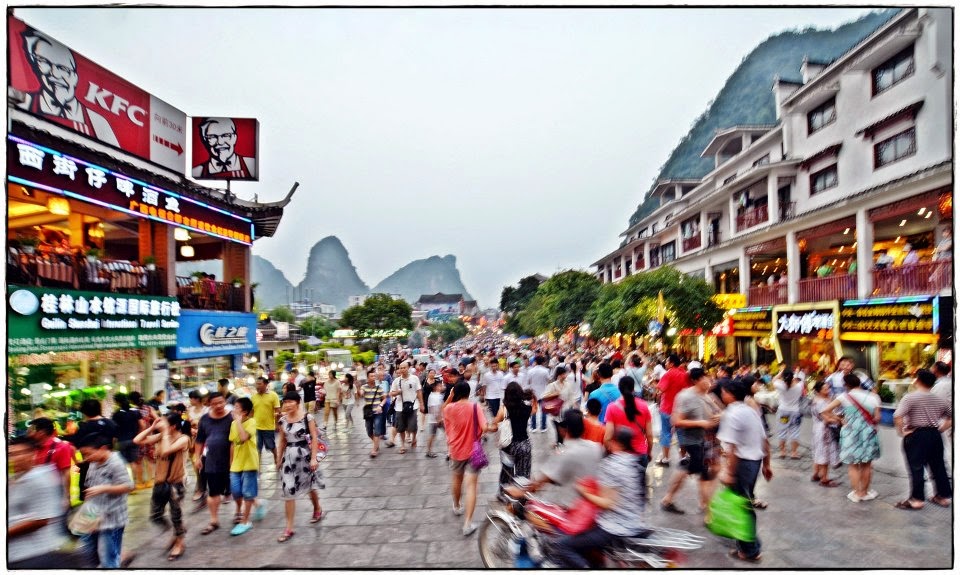


West Street is the oldest street in Yangshuo with a history of more than 1,400 years. Situated at the center of Yangshuo County, the street has become, since the 1980's, a window of eastern and western culture and the biggest 'foreign language center' in China. It is the most prosperous district in Yangshuo, and, each year, approximately 100,000 foreigners come here on their travels or to attend advanced studies. Visitors are attracted to West Street by its unique mix of cultures.

The street is 517 meters (1,696 feet) long and 8 meters (26 feet) wide, meandering in an 'S' along its length. Being completely paved with marble it is a typical example of a southern China street. It is greatly admired by foreigners for its simple style and courtyard-like setting. There is a saying about it that 'half is village while the other half is stores'.


Impression Sanjie Liu


Not far from West market, It's a must see show at night if you were in Yangshuo, ticket is (around) RMB200/person.


Tips : Better not buy any ticket at West Market, better come directly to the area and buy ticket at the official ticket box.


This is the world largest natural theater which utilizes the waters of the Li River as its stage, with twelve mist shrouded hills and the heavens as its backdrop. Mist, rain, moonlight, the hills and their inverted reflections in the river all become the ever-changing natural background. Its auditorium is housed on the natural islands of the river with the audience standing on the designed terraces, surrounded by green plants. The sound equipment here cannot be seen because it is in harmony with the natural environment. The valleys, the hills, the cool breeze and the gurgling streams are all elements contributing to the three-dimensional sound effect. Day by day, different weather offers different sceneries with the four seasons refreshing the performance as well, so you will have unique experience every time you watch it. This is really a new concept opera using nature as an integral part of its performers; hence its name - 'Human's Masterpiece Cooperated with the God'.


The performance is divided into seven chapters including the preface and epilogue. At the beginning, the lights are all turned off and the image of Sanjie appears indistinctly in the sky with beautiful songs 'Sing the folk songs, here I am singing and there you are echoing...'. As the lights come up, the twelve hills appear in front of the audients; and a small fishing boat is rowed from the hills. This is the Preface - the Legend of Hills and Rivers.
The first chapter is the Red Impression: Folk Songs. On the water, many fishermen are rowing their bamboo rafts in a column. Either standing or squatting, they hang the large red silk in the sky and or upon the water. This red picture symbolizes the enthusiasm and praises the labors of the local people.
The second chapter is the Green Impression: Garden. The color green symbolizes nature as well as the vitality. Among the green hills and rivers, the smoke from cooking fires curls upward; herders are heading home with their cattle under the gleam of the sunset. The women, washing clothes beside the water are waiting for their husbands who are rowing the fishing rafts back home. This chapter reveals the peaceful and happy life of the local people.


The third chapter is the Golden Impression: Fishing Lights. Hundreds of bamboo rafts with golden fishing lights are spreading all over the river. The rafts, gently rocking make the golden fishing lights dance upon the waters, the straw rain capes, the frolic cormorants and the hills construct a perfect picture describing the simple existence of the people around the Li River.


The fourth chapter is the Blue Impression: Love Songs. Under the deep blue sky, and on the dark blue water, the performer of Sanjie is singing classical love songs. Then, a crescent-shaped boat with a charming fairy dancing in is flying onto the surface of the water. A group of pretty and young girls, dressed in red or white are bathing around the boat. In this blue world, these beautiful girls seem to become the notes of Sanjie's love songs.


The last chapter is the Silvery Impression: Performance Grand Ceremony. As the 'Wonder of Lijiang Culture', this scenery reflects the traditional ceremony in Sanjie's hometown according to the legend. Over 200 Zhuang girls form a long column across the bridge over the Li River. Their silver dresses make the river shimmer in a mysterious manner.


In the Epilogue, the fishing rafts are rowed farther and farther from the audience while the beautiful songs of Sanjie are still echoing among the hills. The girls on the bridge present their thanks for the audience with their affectionate folk songs.


Except for the perfect seven pictures, the performance also boasts both modern and classical music played by famous musicians of China. Additionally, there are in excess of 600 performers, all of whom are local people of the Li River. They present the reality of life for the people in Sanjie's hometown through their primitive and wonderful performances.


Butterfly Spring Park

It is located in the best traveling place of Moon Hill Scenic Area in Yangshuo, occupying an area of 36,000 square meters (8.9 acres). It is named after a butterfly-like stalactite found in a grotto of this beautiful park. As a locale which brings together both a unique landscape and a rural setting, it is a typical representative of ecotourism sites in Yangshuo.
At the entrance to the Butterfly Spring Park there is a huge Monarch Butterfly model mounted on a cliff beside the gate. The model has an area over 280 square meters (0.07 acres). It looks so vivid that people may think the butterfly is waving its wings to welcome visitors. He Jingzhi, a famous poet in China, visited here and was so astonished by the huge butterfly model that he wrote an inscription titled the No.1 Butterfly under the Heaven to praise it.


Sunday, July 6, 2014

Zhanjiang Chicken


Zhanjiang Chicken (a dish originating in the Zhanjiang region of western Guangdong) is popular on Cantonese menus. Many gourmets go for its robust, savory flavor and deep seasoning, sometimes with ginger.

Friday, October 15, 2010

Nanchang (Jiangxi Province)

October 15, 2010

We arrived at Nanchang city (Jiangxi Province) at 23:53PM at night after a long more than 3 hours train journey from Yiwu.

Train ticket from Yiwu - Nanchang by CRC "D" train : Second Class RMB 158, First Class RMB 188)

We had booked a hotel via CTRIP (a China online travel service provider), and we could get a reasonable price, RMB 139 a night at 3 stars hotel, Yejin Business Hotel, which is only a walking distance of 0.5km from train station, so we don't have to rent a taxi from train station which they (maybe) will overcharge if they know you are foreigner.

When arrived at the train exit, there were so many people offering you taxi or their personal car. For us, we just find a directions to our hotel which is at South Erqi Road (Erqi Nan Lu).
It's quite easy to get, as there were English direction sign.
We walked along the street, which was not as crowded as in the train station, there were only 2 or 3 other people walking in the street, some shops were still open, even though you have to be cautious, but it still safe to walk.

After a few minutes walking from the train station, passing one very bright shop with many young girls inside along the way, we have found our hotel, Yejin business Hotel. We also saw some barbecue, fried dumpling (chien bao), stew pot street food stall near to our hotel. Looks like delicious as many locals were eating together.


Fried Dumpling (Chien Bao), price 1Yuan (US$ 0.15) =4pcs

Husband and wife selling barbecue (price from 1 -2 Yuan (US$ 0.15-0.24)/pc)


Nanchang city at night


Early in the morning, October 16, 2010, we started our journey to Tengwang Pavilion (Pavilion Prince Teng) by taxi from the hotel, it took RMB 18 to reach there.

Same like some other city in China, taxi in Nanchang also has a separator cage from driver
and back passenger, and the different is there is a small camera at the passenger front seat, may be can record who sit there.


TENGWANG PAVILION

Tengwang Pavilion is Nanchang's main symbol, it is the one of four great towers of China and setting for famous poem Tengwang Ge Xuji by Wang Bo during the Tang Dynasty. Tengwang Pavilion is towering pavilion dating to 653, on the east bank of Gan River.


Ticket cost : RMB 50 (Adult), RMB 25 (Student)


THE STAR OF NANCHANG

The Star of Nanchang is a giant 160 metre (525ft) tall Ferris wheel located in eastern Chinese city of Nanchang.
Ticket cost : 50 Yuan
The star of Nanchang City, situated by the side of Ganjing River, is unofficially the world's highest Ferris wheel at almost 162 meters, 25 meters higher than the Eye of London lied at the beach of Times River England.


Public Bus at Nanchang


Taxi & buses are the most popular ways of getting around, bus journey being 1 Yuan per person.
However you will probably find that during peak times both are nearly impossible.


AIRPORT BUS from Nanchang Railway Station


" Transit Bus on Airfield" = Airport Bus


Fare : RMB 10/person

It has some stops from Railway Station to the Airport, takes about 1 hour to reach the airport.

NANCHANG AIRPORT

Nanchang is the city of porcelain.
You can find many of porcelain souvenirs at the airport, but of coure price would be higher than you buy at the city.


Wednesday, January 6, 2010

Harbin

After one day delayed due to heavy snow storm at Beijing, finally we arrived at Harbin airport, on January 4th.

it's the right time to come to harbin on this day.....Harbin Ice and Snow Festival is normally open on a trial basis from December 24 through 31 though it officially opens on January 05 each year. Basically Harbin Ice and Snow Festival lasts till the end of February.
We stayed at Gfour Hotel which situated very near to Zhong Yang Street, and walking distance to Stalin Park, one of the Ice festival (Disney Ice World) and 15 minutes walk to Saint Sophia Cathedral.
Hotel was very good and warm which we really need the most in under 26 degrees Celsius temperature.

Harbin is a sub-provincial city and the capital of the Heliongjiang Province in Northeast China. It lies on the southern bank of the Songhua River. Harbin is the tenth largest city in China (pop. 9.87 million), serving as a key political, economic, scientific, cultural and communications hub in Northeastern China.

The Stalin Park was built in 1953 named after Russian dictator Joseph Stalin. The park is characterized by Russian style flowers and series of statues places along the park.
Harbin is originally a Manchu word meaning "a place for drying fishing nets". Harbin has very cold winters and is often called "Ice City".


Zhongyang Street is a unique European-style pedestrian street, 1450m long with lines of edifices, masses of entertainment areas, and colorful cultural life. All of these buildings are in various styles including renaissance style, baroque style, eclectic style, as well as modern style, the profound history of architecture, a real “Architecture Art Gallery” in China.

As the major refugee center for the East European Jewish, the architecture style of Harbin shows a unique combination of oriental and European architecture styles. Called the Oriental St. Petersburg, Harbin is considered one of China's most beautiful cities. The city is well-known for its unique, Russian and European-influenced architecture.

Zhong Yang Street (Central Street, also known, using the Russian word for Chinese, as Kitaiskaya Street), one of the main business streets in Harbin, is a perfect remnant of the bustling international business activities at the turn of the 20th century. The 1.4-km long street is a veritable museum of European architectural styles: Baroque and Byzantine facades, little Russian bakeries, French fashion houses, American eateries, and Japanese restaurant.
The Russian Orthodox church, Saint Sophia Cathedral, is also located in this central district of Daoli. St. Sophia took nine years to build and was completed in 1932. It has now been made into a museum as a showcase of the multi-cultural architecture of Harbin.


WORLD ICE FESTIVAL


January 4th afternoon, we could not waste time waiting at the cold street by taking bus or struggle to negotiate taxi fare, we just booked a city tour from our hotel to go to the Ice festival for RMB 250/person. They picked us from the hotel at 18:30pm by van with full people inside then we went directly to the place of World Ice festival which just opened that day.
After spending 2 hours there, then we returned to our Hotel.
Officially, the festival starts January 5th and lasts one month. However the exhibits often open earlier and stay longer, weather permitting. Ice sculpture decoration technology ranges from the modern (using lasers) to traditional (with ice lanterns). There are ice lantern park touring activities held in many parks in the city. Winter activities in the festival include Yabuli alpine skiing, winter-swimming in the Songhua River, and the ice-lantern exhibition in Zhaolin Garden.

Ticket : RMB 190/person (I think..can not remember)


DISNEY ICE WORD


This place was just only walking distance from our hotel. It's not big but not bad if you are the first time to go to Harbin. On that day, still there were many sculptures not finished yet, may be it was too early for us to visit.

Ticket : RMB 50/person


HARBIN POLARLAND

Polar Bear! Penguin family of South Polar! In Harbin, you are able to experience the real life of the polar region. Harbin Polarland is the first theme park of polar land scenes in China.Inside the sea-blue elegent building of Pole Aquarium, you will find pure penguin family of South Polar, the most active polar bear brothers in China. There are also the wild arctic wolves introduced for the first time in Asia and the arctic fox brothers who can run on the running machine. The most thrill is the exciting polar land animal show - the performance presented by sea lions. The Polarland Harbin is located just opposite the Sun Island.


Entrance Ticket : RMB 120/person (Include watching shows)


SUN ISLAND

Situated just opposite of Harbin Polar land with in walking distance. It was a Snow Sculptures land, all in white which one of a must see place in Harbin.


Entrance Fee : RMB 150/person


SIBERIAN TIGER PARK


The Siberian Tiger Park was built in 1996.
The park is located on the north bank of the Songhua River to the northwest of Harbin, occupying an area of 1,440,000 square meters (355.8 acres). It is the largest natural park for wild Siberian tigers in the world at present. The park enjoys a favorable foundation for ecotourism and splendid scenery and it is an ideal place for holiday and leisure. There are over 500 purebred Siberian tigers here, with 100 visible to visitors. In addition, visitors can also see white tigers, lions, lynx, leopards, and black pumas as well as Bengali tigers. It is a large park divided into ten areas, including the young tiger area, the mature tiger area, the king tiger area, a walking area and a platform for viewing the tigers. Unlike common zoos, the Siberian Tiger Park exchanges the roles of visitors and animals. Except in the walking area and the platform for viewing the tigers, tourists must take a bus encircled by wire mesh to all the other scenic spots while the tigers roam freely in the fields.


The mature tiger area has an area of 360,000 square meters (89 acres) with 30 unruly Siberian tigers wandering there. The tigers in this area are all about 7 or 8 years old. And in the young tiger area, there are over 40 young lovely, active tigers about 2 years old. Visitors can see them playing and fighting with each other in a pool nearby. Some even younger tigers are kept in the walking area, snuggling together. The park also houses some lions which coexist peacefully with the tigers.
Entrance Ticket : RMB 65/person (Adult)


Tuesday, January 5, 2010

Snow Storm in Beijing

January 3rd, 2010
We planed to go to Harbin departure time at 08:05am with Air China.
But has been delayed until 11:00am due to bad weather, it was heavy snow at the airport at that time.


After boarding at 11:00am, we still waiting in the plane for more than 2 hours and even the plane was trying to take off.

Then, we came back to airport as the flight had been cancelled due to snow storm very bad.

We came back to airport at 15:00pm, and we saw so many people in the Beijing International Airport, because all flight were cancelled.

Long line at every airlines counters, many people struggle to get a new tickets for tomorrow flight. Same with us we felt very desperate that we could not continue our trip to Harbin , we called CTRIP asking whether we could change our flight, and luckily we can get a new flight schedule for tomorrow morning while still many people in the airport had been lined up for so long and might not get their ticket changed.

so next step, where we had to stay overnight? actually we just planned to stay overnight at the airport because we could not go anywhere or even to the city.

But someone offered us a hotel with only RMB 210 for a night which near the airport, we took the offer.
It was a nightmare for us, in that cold weather, the heater in that hotel was broken and no hot water either. Me and my wife slept together in one bed with double blanket and wearing our down jacket, and still felt very cold.

At 5:00am, we quickly check out from the hotel and wait for the shuttle to the airport from the hotel.
Arrived at the airport, we saw so many people lying on the floor, still line up at every the check in counters. But for us, we just asked our tickets then can go to waiting hall.

At 08:00am we were heading to Harbin by China Southern Airlines